
When a crown is placed on a dental implant, there are two main ways to attach it: screw-retained or cement-retained. Both methods work well, but they are chosen in different situations depending on the location of the tooth, the aesthetic requirements, and the need for long-term maintenance.
This guide explains the differences clearly so you can understand why we recommend one option or the other in each case.
How we decide between the two
The choice is not arbitrary. We evaluate several clinical factors:
- The position of the implant (front or back of the mouth)
- The amount of space available for the crown
- The bite forces and occlusion
- Whether the crown may need to be removed in the future
- The desired aesthetic result
In many full-arch rehabilitations (All-on-4 or All-on-6), we prefer screw retention because it makes long-term maintenance much easier.

Cemented implant crown

Screw-retained implant crown
Cement-retained crowns
The crown is cemented onto a prepared abutment, similar to a traditional crown on a natural tooth. There is no visible screw access hole.
Main advantages:
- Better aesthetics, especially in the front of the mouth
- No screw-access hole
- Sometimes requires less vertical space
Important disadvantages:
- Much harder to remove if a problem develops
- Risk of residual cement remaining under the gum, which can irritate the tissues or contribute to peri-implantitis
- Retention depends on the fit and the cement
Screw-retained crowns
The crown is secured to the implant abutment with a screw. The small access hole (chimney) is later filled with tooth-colored resin.
Main advantages:
- The crown can be removed easily if maintenance or repair is needed
- No cement is used, so there is no risk of residual cement under the gum
- Excellent mechanical retention
- Especially useful in the back of the mouth, where chewing forces are higher
The only aesthetic drawback is the small access hole, which is covered with resin but can occasionally be slightly visible.
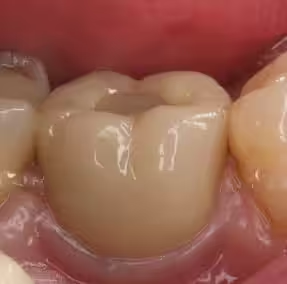
Screw-retained implant crown
What we usually recommend
In the posterior region we almost always prefer screw retention for its safety and ease of maintenance.
In the anterior region we evaluate case by case. When aesthetics are the priority and conditions allow, we may choose cement-retained crowns. However, we increasingly prefer screw-retained solutions in the front as well when it is technically feasible, because long-term control is better.
The final decision is made after reviewing the CBCT, models, and the complete rehabilitation plan.
Planning implant crowns?
If you already have implants or are considering implant treatment, we can review your records and explain which type of retention makes the most sense for your case.
Send us your X-rays or CBCT and a short description of your situation. We will reply with a clear recommendation and a cotización.
USA & Canada: +1 (888) 398-5854
WhatsApp: +51 995-540-050
Peru: +511 242-2152