Dental Bridges
A dental bridge is a fixed restoration used to replace one or more missing teeth. It is anchored to the natural teeth or implants on either side of the gap, restoring both chewing function and appearance while preventing the remaining teeth from shifting.
Dental bridges remain a reliable option for patients who are not candidates for dental implants, who prefer a faster treatment timeline, or whose adjacent teeth already need crowns.
We focus on restorations that are functional, comfortable, and aesthetically natural. Material selection (porcelain, zirconia, or other high-strength ceramics) depends on the location of the bridge, the patient’s bite, and aesthetic priorities.
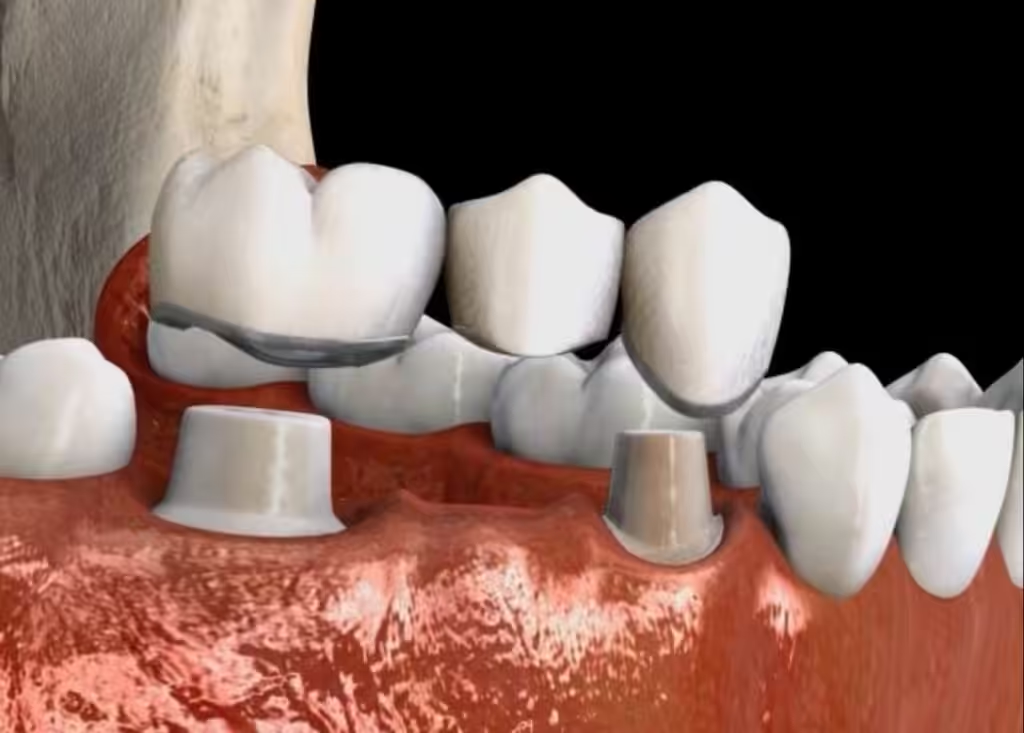
Custom dental bridges designed and fabricated with digital technology at Smiles Peru
Types of dental bridges
- Traditional dental bridge
The most common type. One or more artificial teeth (pontics) are held in place by dental crowns cemented onto the teeth adjacent to the gap. - Cantilever bridge
Used when there is only one natural tooth next to the missing tooth. The bridge is supported by a single crown on one side. Normally not recommended. - Maryland bridge (resin-bonded / adhesive bridge)
A more conservative option that uses metal or porcelain wings bonded to the back of the adjacent teeth. It requires minimal preparation of the natural teeth and can often be completed more quickly. - Implant-supported bridge
Instead of relying on natural teeth, this bridge is fixed onto dental implants. It offers greater stability, does not damage neighboring teeth, and helps preserve bone over time.
Dental Bridge vs Dental Implant
| Aspect | Dental Bridge | Dental Implant |
|---|---|---|
| Support | Natural teeth or implants | Dental implants only |
| Effect on neighbors | Requires reshaping adjacent teeth | Does not affect neighboring teeth |
| Bone preservation | Does not prevent bone loss under the gap | Helps preserve jawbone |
| Longevity | Typically 10–15 years | Can last a lifetime with proper care |
| Initial cost | Usually more affordable | Higher initial investment |
| Treatment time | Faster | Longer (several months) |
| Maintenance | Requires careful hygiene under the bridge | Easier daily cleaning around implants |
When the neighboring teeth are healthy, an implant is often the preferred long-term solution. When those teeth already need crowns, a traditional bridge can be an excellent and more economical choice.
For full-arch implant solutions, see our Zirconia Implant Bridge and Hybrid Prosthesis pages.
Benefits of dental bridges
- Restore the ability to chew and speak properly
- Improve the appearance of your smile
- Prevent remaining teeth from shifting out of position
- Provide a fixed (non-removable) solution
- Generally require less treatment time than dental implants
- Cost-effective option in many clinical situations
The Dental Bridge Procedure at Smiles Peru
- Evaluation and planning
Clinical examination plus X-rays or 3D scans to determine the most suitable type of bridge. - Tooth preparation (when needed)
The abutment teeth are carefully shaped to receive the supporting crowns. - Digital impressions
We take precise digital scans (or traditional impressions when indicated) for the custom bridge. - Temporary bridge
A temporary restoration is placed while the permanent bridge is fabricated. - Final placement
The permanent bridge is tried in, adjusted for perfect fit and bite, and cemented or screw-retained.
At Smiles Peru we use digital design and our in-house laboratory capabilities (including CEREC and high-quality zirconia) to achieve precise, natural-looking results with controlled turnaround times.
Frequently Asked Questions
What is a dental bridge?
A fixed restoration that replaces one or more missing teeth by anchoring artificial teeth to the natural teeth or implants on either side of the gap.
What types of bridges do you offer?
Traditional, cantilever, Maryland (resin-bonded), and implant-supported bridges.
Bridge or implant — which should I choose?
Implants preserve bone and leave neighboring teeth untouched, but take longer and cost more initially. Bridges are faster and often more affordable, especially when the adjacent teeth already need crowns. We evaluate each case individually.
How long do dental bridges last?
With good hygiene and regular check-ups, 10–15 years or longer is realistic. Implant-supported bridges frequently last even longer.
Is the procedure painful?
No. It is performed under local anesthesia. Most patients report little to no discomfort.
How much does a dental bridge cost?
Cost depends on the type of bridge, the number of teeth replaced, and the materials used. Send us your X-rays or photos for a personalized estimate or see our prices page.
What is an adhesive / Maryland bridge?
A conservative bridge that bonds to the back of adjacent teeth with minimal preparation. It can often be completed more quickly than a traditional bridge.
Complimentary online consultation
Briefly describe your case and send us photos of your smile (and X-rays if available) to info@smilesperu.com or use our contact form. We will send you a treatment plan and cost estimate within 24 hours.
Contact Us