Sinus Lift
Have you been told you do not have enough bone in the upper back jaw for dental implants?
After the loss of upper molars or premolars, two things often happen: the remaining bone resorbs and the maxillary sinus expands downward. The result is insufficient vertical height to place implants safely and with good primary stability.
A sinus lift (also called sinus elevation or sinus augmentation) gently raises the sinus membrane and creates the additional bone volume needed. At Smiles Peru we plan every case with 3D CBCT so the elevation is precise, the approach is as conservative as possible, and dental implants can frequently be placed in the same surgery.
Why a Sinus Lift is Needed
When an upper posterior tooth is lost, the vacant socket collapses and the sinus floor drops. Over months and years this reduces the bone available for an implant. Patients who have worn removable partial dentures for a long time or who lost teeth many years ago are especially likely to need this procedure.
Without adequate height, conventional implants cannot be placed in the ideal position. A well-executed sinus lift restores that height so that implants—and full-arch solutions such as All-on-4 or All-on-6—become predictable again.
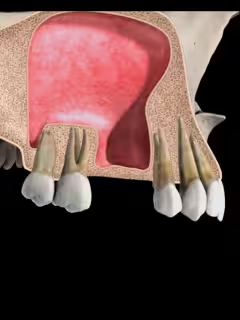
After upper posterior extractions, subsequent lack
of bone stimulation causes the maxillary
sinus to extend downwards
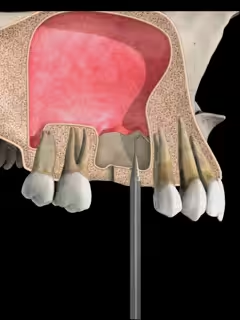
Sinus lift increases the height of the upper jawbone
to allow for the placement of implants
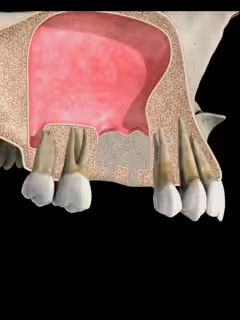
Once the sinus membrane has been lifted,
bone graft material is inserted
Sinus Lift Techniques at Smiles Peru
We select the technique according to the residual bone height measured on the CBCT:
Grafted vs graftless
Most cases receive a xenograft or other bone substitute under the elevated membrane. In carefully selected situations a pure membrane elevation (graftless) can be sufficient.
Lateral window (classic)
Access through a small window in the side wall of the maxillary bone. Preferred when a larger height increase is required.
Crestal / osteotome (minimally invasive)
Access from the alveolar crest using osteotomes. Less invasive, shorter recovery, suitable when residual bone is closer to the minimum needed.
Simultaneous placement
Implants are placed in the same surgery whenever residual bone is ≥5–6 mm. This is our preferred approach because it reduces the number of procedures and overall treatment time.
Who is a Good Candidate for a Sinus Lift?
You may be a candidate if:
- You have been told there is not enough bone height in the upper back jaw
- You lost upper molars or premolars years ago and the sinus has expanded
- You are planning single implants, multiple implants, or a full-arch solution (All-on-4 / All-on-6) in the upper jaw
- You are in good general health and can follow post-operative instructions
If you already have a panoramic X-ray or CBCT, we can evaluate the residual bone and tell you whether a sinus lift is required and which technique would be most appropriate.
How the Sinus Lift Procedure works
- Precise diagnosis
A 3D CBCT scan measures residual bone height, sinus anatomy, and membrane thickness. This determines the exact technique and whether simultaneous implant placement is possible. - Anesthesia and comfort
Local anesthesia is used. - Membrane elevation
The Schneiderian membrane is carefully lifted through either a lateral or crestal approach. The space created is filled with bone graft material when indicated. - Implant placement (when possible)
If residual bone allows, the implants are seated in the same session. - Closure and healing
The site is sutured. Soft-tissue healing takes 2–4 weeks. Full bone integration is verified with a control CT scan at 4–6 months before the final prosthesis is delivered.
Benefits of Sinus Lift at Smiles Peru
- Makes implant treatment possible in the posterior upper jaw even with significant bone loss
- High success rates supported by 3D-guided planning
- Possibility of simultaneous implant placement (fewer surgeries, shorter overall timeline)
- Preserves facial contours and chewing function
- Coordinated team of maxillofacial surgery and implant specialists
- Clear aftercare protocol and scheduled follow-up tomography
Recovery and Aftercare
Most patients experience mild swelling and discomfort for 5–10 days. This is controlled with prescribed medication and a soft diet for the first 1–2 weeks.
Key instructions:
- Avoid forceful nose blowing or sneezing with a closed mouth
- No smoking during the healing period
- Antibiotics and pain medication exactly as prescribed
- Attend all scheduled follow-up visits
You can usually return to normal daily activities within a few days. Full bone maturation takes 4–6 months; we confirm readiness with a control CT before proceeding to the final restoration.
Frequently Asked Questions
What is a sinus lift / sinus elevation?
It is a procedure that gently lifts the membrane at the floor of the maxillary sinus and creates additional bone height so dental implants can be placed securely in the posterior upper jaw.
Why do I need one?
Tooth loss leads to bone resorption and downward expansion of the sinus. Without enough vertical bone, an implant cannot achieve primary stability or the correct prosthetic position.
Does the procedure hurt?
It is performed under local anesthesia (with optional conscious sedation). Post-operative discomfort is usually mild and lasts 5–10 days.
How long until I get my final teeth?
Soft-tissue healing is rapid. Full bone integration takes 4–6 months. A control CT confirms that the site is ready for the final prosthesis.
Can the implants be placed at the same time?
Yes—when residual bone is ≥5–6 mm we routinely place the implants during the same surgery (simultaneous technique).
What are the risks?
Temporary swelling and discomfort are expected. Membrane perforation, infection, or delayed healing are uncommon when the procedure is planned with 3D imaging and performed by an experienced team.
How much does it cost?
The fee depends on residual bone height, technique, graft material (if used), and whether implants are placed simultaneously. Send us your X-rays for a personalized outline and estimate.
Complimentary online consultation
Briefly describe your case and send us photos of your smile (and X-rays if available) to info@smilesperu.com or use our contact form. We will send you a treatment plan and cost estimate within 24 hours.
Contact Us