Bone Graft
If tooth loss, gum disease, trauma, or years of dentures have reduced your bone, an implant cannot sit securely or in the right position.
We rebuild that bone with a graft (bone regeneration), then plan the implant in 3D so it can be placed with the stability it needs — including cases that were turned down elsewhere.
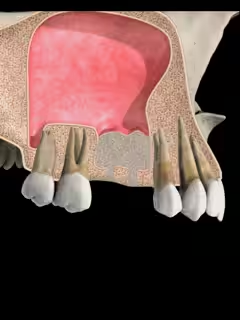
Bone graft (powder form) added for an
immediate or future dental implant
Why Bone Quality Matters
The long-term success of a dental implant depends heavily on the quantity and quality of the bone that surrounds it. After an extraction the alveolar bone gradually resorbs. Over time this can leave a ridge that is too narrow or too short for conventional implant placement.
A well-planned bone graft restores the anatomical foundation, improves primary stability, supports soft-tissue contours, and contributes to both the functional and aesthetic result of the final restoration.
When a Bone Graft is Recommended
A graft may be advised in these situations:
- Significant bone loss after extractions or long-term missing teeth
- Advanced periodontal disease that has reduced the height or width of the ridge
- Trauma or infection that has damaged the bone
- Cases where a sinus lift is needed in the upper posterior jaw (see our sinus lift page)
- Preparation for full-arch treatments such as All-on-4 or All-on-6 when residual bone is limited
During the planning phase we evaluate a 3D CBCT scan to determine exactly how much additional bone is required and whether the graft can be performed at the same time as implant placement.
How the Bone Grafting Procedure Works
- Precise diagnosis – A 3D CT scan (CBCT) measures bone height, width, and density and lets us plan the graft in three dimensions.
- Anesthesia and comfort – Local anesthesia is used.
- Graft placement – The deficient area is accessed through a small incision. The graft material (powder, block, or a combination) is positioned and covered with a protective membrane that guides regeneration and keeps soft tissue from invading the site.
- Closure – The area is sutured. In many cases implants can be placed in the same surgery when residual bone allows.
- Healing– The graft integrates over 4 to 6 months. A follow-up CT scan confirms that the new bone is ready before the final restorative phase.
Benefits of Bone Grafting at Smiles Peru
- Makes implant treatment possible in cases of advanced bone loss
- Improves primary stability and long-term implant success
- Helps preserve facial contours and soft-tissue support
- 3D-guided planning for greater precision and a less invasive approach
- Experienced interdisciplinary team that routinely manages complex ridge deficiencies
- Option to combine the graft with implant placement (including All-on-4 / All-on-6 approaches) to shorten overall treatment time
Recovery and What to Expect
Most patients experience mild swelling and discomfort for 3–7 days. This is managed with prescribed medication and a soft diet for the first 1–2 weeks.
Important aftercare points:
- Strict oral hygiene as instructed
- No smoking during the healing period
- Antibiotics and pain medication as prescribed
- Scheduled follow-up visits
Full bone integration typically takes 4–6 months. Once the control scan confirms readiness, we proceed with the final implants or prosthesis.
Who is a Good Candidate?
You may be a candidate if you have been told there is not enough bone for implants, or if you have noticed progressive ridge shrinkage after extractions or long-term denture wear. Good general health and the ability to follow post-operative instructions improve outcomes.
If you already have a panoramic X-ray or CBCT, we can evaluate whether grafting is necessary and how it would fit into a complete treatment plan.
Frequently Asked Questions
What is a bone graft for dental implants?
A bone graft rebuilds or increases jawbone volume so implants have a stable foundation. We place graft material (powder, block, or combination) and cover it with a membrane that guides new bone formation.
Why might I need a bone graft?
Tooth loss leads to natural bone resorption. Without sufficient height and width, an implant cannot be placed securely or in the ideal prosthetic position.
Does the procedure hurt?
It is performed under local anesthesia. Optional conscious sedation is available. Most patients report only mild discomfort for a few days afterward.
How long does healing take?
Soft-tissue healing is usually complete in 2–4 weeks. Full bone integration requires 4–6 months. We confirm progress with a control CT scan before moving to the next phase.
Can the implant be placed at the same time as the graft?
Yes, in many cases. When residual bone permits, we use a simultaneous technique. Full-arch approaches such as All-on-4 or All-on-6 frequently allow us to place implants while grafting limited areas.
What is the approximate cost?
Cost varies according to the volume of material needed and whether the graft is combined with implant placement. Send us your X-rays for a personalized treatment plan and estimate.
Complimentary online consultation
Briefly describe your case and send us photos of your smile (and X-rays if available) to info@smilesperu.com or use our contact form. We will send you a treatment plan and cost estimate within 24 hours.
Contact Us